
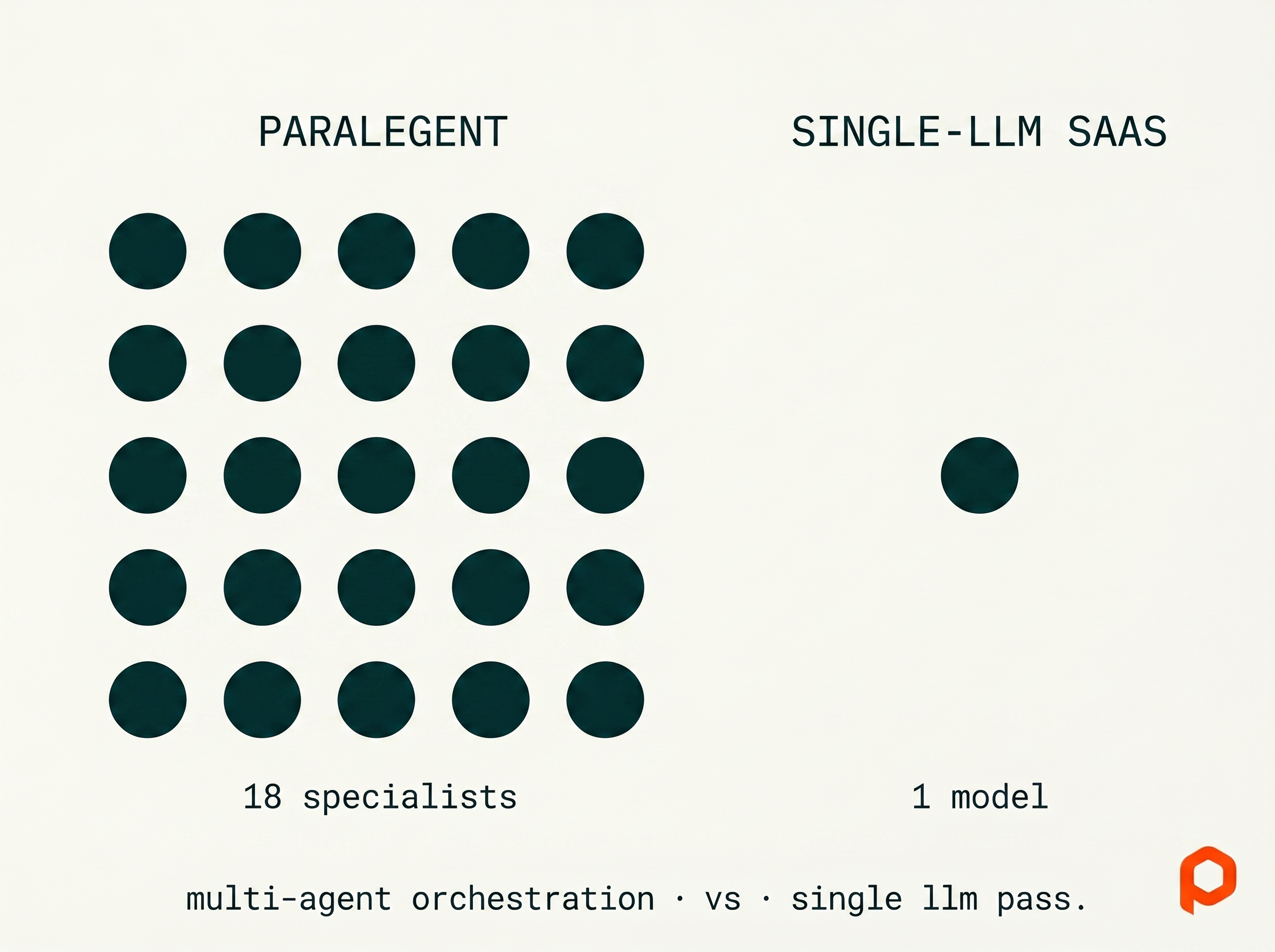
Multi-agent orchestration vs single LLM.
Paralegent AI enforces your organization's standards across every contract with 18+ specialized agents deployed in your own cloud. Spellbook helps individual lawyers draft and redline using GPT-5 and Claude on Spellbook's SaaS infrastructure.
For enterprise legal teams evaluating Spellbook against Paralegent AI.
Your cloud, not vendor SaaS.
Paralegent AI deploys inside your Azure, AWS, or Google Cloud. Your contracts never leave your environment. Spellbook processes contracts on its own SaaS infrastructure.
18+ specialized agents.
Each agent focuses on one legal category — Warranty, IP, Termination, Compliance. An orchestrator resolves conflicts by confidence score. Spellbook uses a single LLM pass.
GREEN / ORANGE / RED.
Every clause gets a structured risk tier, rationale, confidence percentage, and approved replacement language. Spellbook produces suggestions without structured risk tiers.
Why multi-agent orchestration outperforms a single LLM.
Spellbook runs contract review as a single LLM call. Paralegent AI routes each section to 18+ domain-specific agents. Here is why that matters for enterprise legal teams.
Stanford research (2024) found that general-purpose LLMs produce 69-88% legal fact hallucination rates on verifiable legal questions. When general-purpose LLMs attempt contract review — even using GPT-5 or Claude — they apply generic knowledge, not your company's specific positions across 18+ legal categories. Paralegent AI solves this with 18+ specialized agents: the Warranty Agent only evaluates warranties, the IP Agent only reviews intellectual property, the Termination Agent only analyzes termination rights. An orchestrator compares confidence scores and surfaces only high-confidence findings — producing 40-50 precise redlines per MSA in 2-8 minutes.
- Data sovereignty by design — Spellbook processes contracts on its own infrastructure (SOC 2 certified, but data leaves your environment). Paralegent AI runs inside your Azure, AWS, or Google Cloud. Your contracts never reach our servers. Zero data egress.
- Domain expertise per category — When general-purpose LLMs attempt contract review, they treat Warranty and Force Majeure the same. 18+ specialized agents each have deep context in their legal domain, trained on your 80-150 term playbook.
- Structured GREEN/ORANGE/RED output — Spellbook produces suggestions and unstructured redlines. Paralegent AI classifies every clause with a risk tier, the specific playbook rule violated, rationale, confidence percentage, and approved replacement language.
- Company-wide enforcement — Spellbook's playbooks are per-user. Paralegent AI enforces a single company-wide playbook uniformly across every reviewer and every contract. No variation based on who is reviewing.
- You control the models — Spellbook selects which LLM runs your review. With Paralegent AI, you use your own Azure OpenAI, Bedrock, or Vertex AI keys — under your contracts, your security controls, your compliance posture.
Full feature comparison.
Paralegent AI leads in deployment model, AI architecture, data sovereignty, risk classification, and total cost of ownership.
| Paralegent AI | Spellbook | |
|---|---|---|
| Deployment | Your cloud (Azure / AWS / GCP) | Spellbook's SaaS cloud |
| Data sovereignty | Data never leaves your env | Data on Spellbook servers |
| AI architecture | 18+ specialized agents | Single LLM pass (GPT-5/Claude) |
| Risk classification | GREEN / ORANGE / RED + rationale | Suggestions and redline text |
| Replacement language | Approved per clause from playbook | Suggested edits |
| Playbook enforcement | Company-wide, uniform | Per-user playbooks |
| Microsoft Word | ✓ Native Add-in | ✓ Native Add-in |
| Audit trail | ✓ Full clause-level log | Limited |
| Pricing model | One-time deployment (custom) | ~$20-$179/user/month (estimated) |
| LLM choice | You choose (Azure/Bedrock/Vertex) | Spellbook chooses |
| Data used for training | Never — zero data on our servers | No per Spellbook terms |
| Implementation | 8-10 weeks, dedicated pod | Self-serve SaaS signup |
5 things that separate Paralegent AI from Spellbook.
Both are Word-native. Both review contracts. The architecture, deployment, and enforcement model are fundamentally different.
Multi-agent vs single LLM
Spellbook uses a single LLM pass (GPT-5, Claude). Paralegent AI deploys 18+ specialized agents — each focused on one legal category — with an orchestrator that resolves conflicts by confidence score.
Your cloud vs vendor cloud
Spellbook processes contracts on its own infrastructure (SOC 2 certified). Paralegent AI deploys in your Azure, AWS, or Google Cloud. Your contracts never leave your environment. Zero data egress.
Company-wide vs per-user
Spellbook playbooks are configured per user. Paralegent AI enforces a single company-wide playbook with 80-150 terms uniformly — every reviewer, every contract, same standards.
Structured output vs suggestions
Paralegent AI produces GREEN/ORANGE/RED classification with rationale, confidence score, playbook rule violated, and approved replacement language. Spellbook produces redline suggestions without structured risk tiers.
One-time vs subscription
Spellbook uses custom per-seat pricing (industry estimates range from $20-$179/user/month). Paralegent AI is a one-time production deployment — 8-10 weeks with a dedicated engineering pod. Your team operates independently after go-live.



See Paralegent AI review a real contract.
30-minute live demo — we analyze one of your contracts against a sample playbook, in Microsoft Word.
Common questions.
The most frequent questions enterprise legal teams ask when comparing Paralegent AI to Spellbook.
What AI models does Spellbook use?
Spellbook uses GPT-5, Claude, and other LLMs, benchmarking against 2,300+ contract types. Customers cannot configure which model is used. Paralegent AI is LLM-agnostic: you choose Azure OpenAI, Bedrock, or Vertex AI running in your own cloud account.
Does Spellbook deploy in my cloud?
No — Spellbook is SaaS. Your contracts are processed on Spellbook's infrastructure. Paralegent AI deploys inside your Azure, AWS, or Google Cloud. Your data never leaves your environment. You own the deployed system entirely.
Does Spellbook have a playbook system?
Spellbook supports custom playbooks for encoding positions, but review is a single LLM pass — not 18+ specialized agents each focused on a specific legal category. No GREEN/ORANGE/RED classification with rationale and confidence scoring.
How does pricing compare?
Spellbook uses custom per-seat pricing (industry estimates range from $20-$179/user/month, billed annually). Paralegent AI is a one-time production deployment — custom-scoped to your contracts, cloud, and team. No recurring subscription fees. For teams of 10+, total cost of ownership is typically lower.
Can Spellbook produce redlines in Word?
Yes — both are Word-native. Both produce redlines directly in Microsoft Word. The difference is AI architecture: Spellbook uses a single LLM pass while Paralegent AI uses 18+ specialized agents with multi-agent orchestration and confidence-based conflict resolution.
Which is better for enterprise in-house legal?
Spellbook is strong for individual lawyer productivity and drafting assistance. Paralegent AI is built for enterprise teams needing company-wide playbook enforcement across 18+ legal categories, data sovereignty, and 18+ specialized agents.
Does Spellbook enforce company-wide standards?
Spellbook's playbooks are configured per user. Paralegent AI enforces a single company-wide playbook with 80-150 custom terms uniformly — every reviewer, every contract, same standards. No variation based on who is reviewing.
How does data sovereignty differ?
Spellbook processes contracts on its own cloud (SOC 2 Type II certified). Paralegent AI deploys in YOUR cloud — Azure, AWS, or Google Cloud. You use your own LLM accounts. Zero data egress. Your contracts never touch a third-party server.
What is multi-agent orchestration?
Paralegent AI routes each contract section to a specialized agent — Liability, IP, Termination, Compliance, and more. 18+ agents analyze in parallel. An orchestrator resolves conflicts by confidence score. This produces higher accuracy than a single LLM pass.
How long does Paralegent AI implementation take?
Typical implementation is 8-10 weeks with a dedicated pod of 3-4 engineers. Covers playbook design (80-150 terms), cloud deployment, CLM integration (Agiloft, DocuSign, Icertis, Ironclad), testing with real contracts, and team training.
Evaluating more than one option? See how Paralegent AI stacks up against manual contract review workflows, Harvey AI’s general legal platform, LegalOn’s pre-built playbooks, and using ChatGPT for contract review — or start with what AI contract review actually is and the AI contract review glossary for the vocabulary behind every comparison.