
Why ChatGPT fails at contract review.
Stanford research (2024): general-purpose LLMs produce 69-88% legal fact hallucination rates on verifiable legal questions. ChatGPT has no playbook, no classification, no redlines. Paralegent AI deploys 18+ specialized agents in your cloud with GREEN/ORANGE/RED classification and approved replacement language per clause.
For legal teams evaluating ChatGPT or GPT-4 for contract review.

69-88% hallucination rate vs specialized agents.
Stanford research (2024) found general-purpose LLMs produce 69-88% legal fact hallucination rates on verifiable legal questions. Paralegent AI constrains 18+ agents to specific legal domains anchored to your 80-150-term playbook.
Chat text vs classified redlines.
ChatGPT produces conversational paragraphs. Paralegent AI produces 40-50 classified redlines per MSA — GREEN/ORANGE/RED with rationale, confidence score, and approved replacement language.
Vendor servers vs your cloud.
Pasting contracts into ChatGPT sends data to OpenAI's servers. Paralegent AI deploys inside your Azure, AWS, or Google Cloud. Zero data egress.
Why pasting contracts into ChatGPT is dangerous.
ChatGPT is a general-purpose chatbot. It has no playbook, no classification system, no Word integration, and no audit trail. Here is why that matters.
Stanford research (2024) found that general-purpose LLMs produce 69-88% legal fact hallucination rates on verifiable legal questions (GPT-4 alone showed a 58% hallucination rate). These models hallucinate legal provisions, miss jurisdiction-specific requirements, and apply inconsistent standards across clauses. When a legal team pastes an 80-page MSA into ChatGPT, they get unstructured conversational text — not classified redlines, not approved replacement language, not a defensible audit trail. Worse, that contract data is now on OpenAI's servers. For enterprise legal teams processing hundreds of contracts per year, this is not a cost-saving shortcut — it is a liability risk.
- 69-88% legal fact hallucination rate — Stanford research (2024) documented that general-purpose LLMs hallucinate legal provisions, invent case citations, and misapply jurisdiction-specific rules. GPT-4 alone showed a 58% hallucination rate. A single missed liability cap or IP assignment error can cost more than the entire contract value.
- No playbook, no standards — ChatGPT has no concept of your company's positions, preferred language, or risk thresholds. Each prompt produces different results. Paralegent AI applies 80-150 custom terms uniformly across every clause on every contract.
- Chat text, not classified redlines — ChatGPT produces paragraphs of conversational text. Paralegent AI produces GREEN/ORANGE/RED classification with rationale, confidence score, playbook rule violated, and approved replacement language — directly in Microsoft Word.
- Your data on vendor servers — Pasting contracts into ChatGPT sends data to OpenAI's servers. Paralegent AI deploys in YOUR cloud — Azure, AWS, or Google Cloud. Your contracts never leave your environment. Zero data egress.
- No audit trail — ChatGPT conversations are not defensible documentation. Paralegent AI produces a full clause-level audit trail: every clause reviewed, classification applied, playbook rule triggered, and replacement language proposed.
Full feature comparison.
ChatGPT is a chatbot. Paralegent AI is a production contract review system. The difference is structural.
| Paralegent AI | ChatGPT / GPT-4 | |
|---|---|---|
| Legal accuracy | 18+ specialized agents | 69-88% hallucination rate (Stanford 2024) |
| Output format | GREEN / ORANGE / RED redlines in Word | Unstructured chat text |
| Playbook enforcement | 80-150-term custom playbook | No playbook — prompt-dependent |
| Data location | Your cloud (Azure / AWS / GCP) | OpenAI's / Anthropic's servers |
| Microsoft Word | ✓ Native Add-in | ✗ No integration |
| CLM integration | ✓ Agiloft, DocuSign, Icertis, Ironclad | ✗ No integration |
| Risk classification | GREEN / ORANGE / RED + rationale | No classification system |
| Replacement language | Approved per clause from playbook | Generic AI suggestions |
| Audit trail | Full clause-level log | Chat history only |
| Hallucination control | Constrained to playbook + escalation | No guardrails |
| Consistency | Same playbook, every contract | Different results per prompt |
| Data used for training | Never — zero data on our servers | Possible per vendor terms |
5 reasons ChatGPT is not a contract review tool.
ChatGPT is impressive for general tasks. Contract review requires specialized architecture, structured output, and data sovereignty.
69-88% legal fact hallucination rate
Stanford research (2024) documented that general-purpose LLMs produce 69-88% hallucination rates on verifiable legal questions — GPT-4 alone showed 58%. A contract review tool with these error rates is worse than no tool at all.
Chat text vs classified redlines
ChatGPT produces unstructured conversational paragraphs. Paralegent AI produces 40-50 classified redlines per MSA — GREEN/ORANGE/RED with rationale, confidence score, and approved replacement language — directly in Microsoft Word.
No playbook, no consistency
ChatGPT has no concept of your company's positions. Each prompt produces different results. Paralegent AI enforces 80-150 custom terms with preferred positions and risk thresholds — uniformly across every contract.
Your data on vendor servers
Pasting an 80-page MSA into ChatGPT sends confidential contract data to OpenAI's servers. Paralegent AI deploys in your Azure, AWS, or Google Cloud. Zero data egress. Your contracts never leave your environment.
No Word integration, no CLM support
ChatGPT has no Microsoft Word integration and no CLM connections. Paralegent AI works natively inside Word and integrates with Agiloft, DocuSign CLM, Icertis, and Ironclad.

See what real contract review looks like.
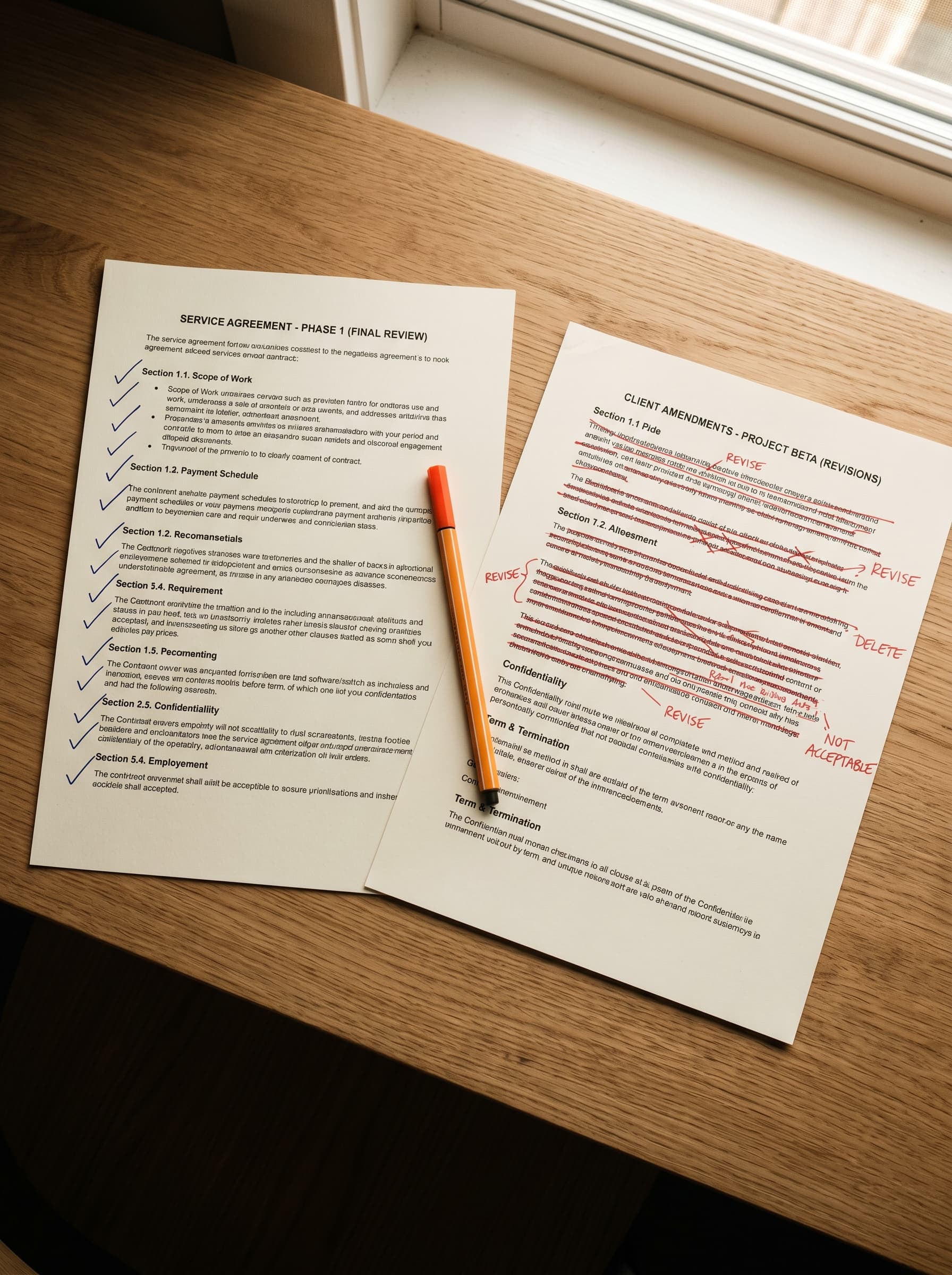
We'll review one of your contracts against a sample playbook — classified redlines, not chat text.
Common questions.
The most frequent questions enterprise legal teams ask about using ChatGPT for contract review.
What is ChatGPT's error rate on legal analysis?
Stanford research (2024) found that general-purpose LLMs produce 69-88% legal fact hallucination rates on verifiable legal questions (GPT-4 alone showed a 58% hallucination rate). Generic LLMs hallucinate legal provisions, miss jurisdiction-specific requirements, and apply inconsistent standards across clauses. This is not a tool — it is a liability risk.
Why does generic AI fail at contract review?
Generic LLMs like ChatGPT have no playbook, no classification system, and no understanding of your company's specific positions. They produce unstructured chat text — not classified redlines. Paralegent AI applies 80-150 custom terms with GREEN/ORANGE/RED classification across 18+ legal categories.
Is pasting contracts into ChatGPT a data privacy risk?
Yes — when you paste a contract into ChatGPT, that data is sent to OpenAI's servers. OpenAI's terms allow data use for model improvement unless you opt out. Paralegent AI deploys in YOUR cloud — Azure, AWS, or Google Cloud. Your contracts never leave your environment.
Can ChatGPT produce structured contract redlines?
No — ChatGPT produces conversational text responses. It cannot generate GREEN/ORANGE/RED classification, inline Word comments, approved replacement language per clause, or structured audit trails. Paralegent AI produces 40-50 classified redlines per MSA directly in Microsoft Word.
How does Paralegent AI prevent hallucinations?
Paralegent AI uses 18+ specialized agents — each constrained to a specific legal category and anchored to your 80-150-term playbook. An orchestrator resolves conflicts by confidence score. Clauses outside the playbook are escalated to lawyers, not auto-classified.
Does ChatGPT enforce company-wide contract standards?
No — ChatGPT has no concept of your company's positions, preferred language, or risk thresholds. Each user writes different prompts and gets different results. Paralegent AI enforces a single company-wide playbook with 80-150 terms uniformly across every contract.
Can ChatGPT integrate with Microsoft Word or CLM systems?
ChatGPT has no native Word integration for contract review and no CLM integrations. Paralegent AI works natively inside Microsoft Word and integrates with Agiloft, DocuSign CLM, Icertis, and Ironclad.
What is the difference between chat output and classified redlines?
ChatGPT produces paragraphs of conversational text — no structure, no risk tiers, no audit trail. Paralegent AI produces classified redlines: GREEN (favorable), ORANGE (conditional), or RED (unacceptable) with rationale, confidence score, playbook rule violated, and approved replacement language.
Is ChatGPT free for contract review?
ChatGPT Plus costs $20/month but general-purpose LLMs produce 69-88% legal fact hallucination rates on verifiable legal questions. The cost of a single missed clause — an auto-renewal trap, a liability cap deviation, an IP assignment issue — far exceeds any subscription savings. Paralegent AI is a one-time production deployment built for accuracy.
How long does Paralegent AI implementation take?
Typical implementation is 8-10 weeks with a dedicated pod of 3-4 engineers. Covers playbook design (80-150 terms), cloud deployment (Azure, AWS, or GCP), CLM integration (Agiloft, DocuSign, Icertis, Ironclad), testing with real contracts, and team training.
Evaluating more than one option? See how Paralegent AI stacks up against manual contract review workflows, Spellbook’s Word add-in, Harvey AI’s general legal platform, and LegalOn’s pre-built playbooks — or start with what AI contract review actually is and the AI contract review glossary for the vocabulary behind every comparison.