
Your contract standards. Digitized and enforced.
Every legal team has contract review standards — preferred positions, fallback language, approval chains. Paralegent AI converts those standards into a structured playbook with 80-150 enforceable terms across 18+ legal categories. Upload once, enforce on every clause-level review.
For in-house counsel and procurement teams that want consistent contract review standards.

67% of contract disputes originate from inconsistent application of review standards.
Most legal teams have standards — the problem is enforcement. Guidelines live in scattered Word documents, PDFs, or the heads of departing senior counsel. A Paralegent AI playbook makes those standards machine-readable and enforceable.
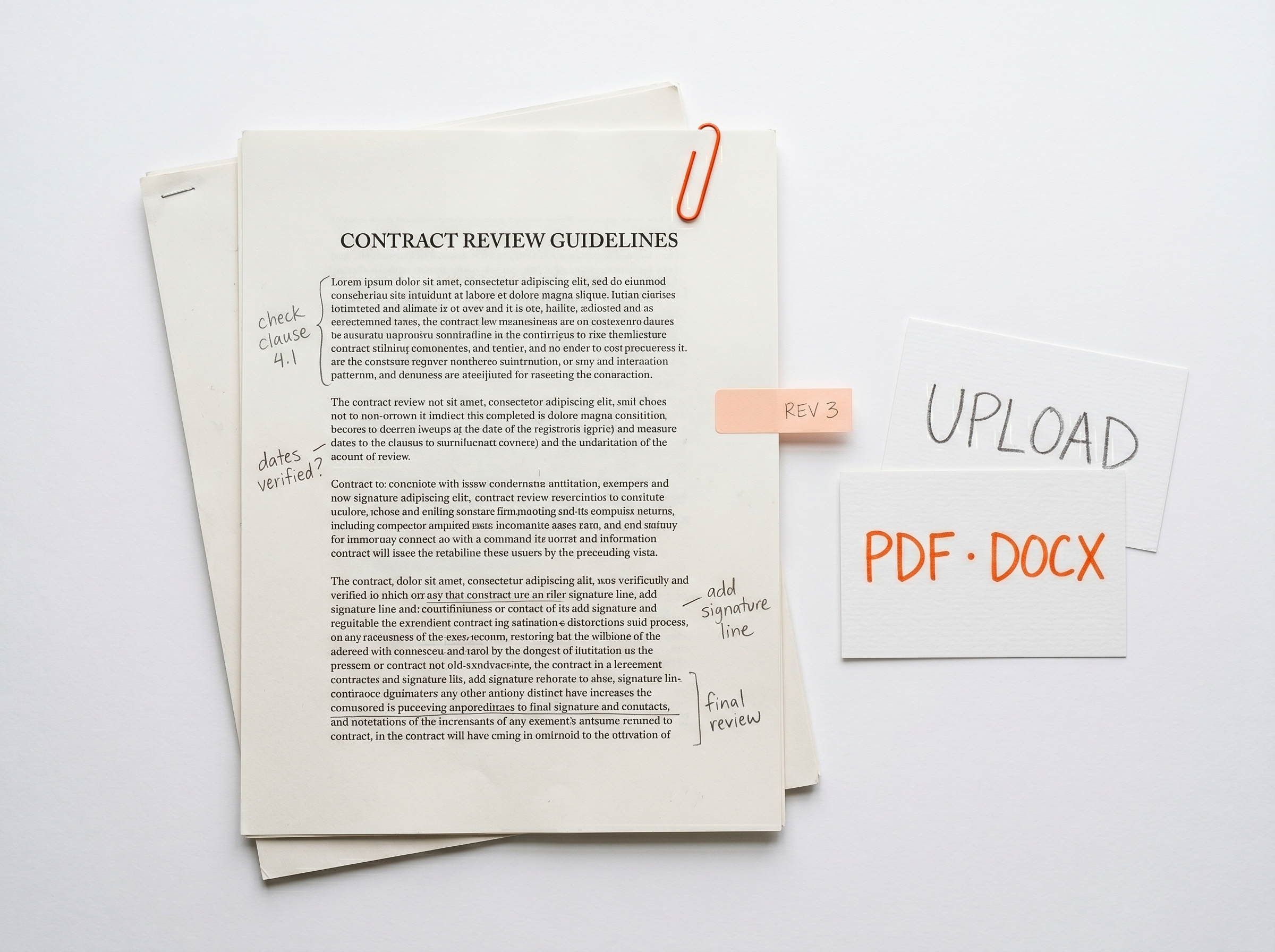
Upload your existing guidelines as PDF or DOCX.
Your legal department playbook, procurement compliance checklist, or any document that describes how your team evaluates contract terms. The extraction engine parses headings, bullet points, tables, and narrative paragraphs to identify individual terms — producing 80-150 structured terms.
- PDF or DOCX, up to 50 MB
- Parses headings, bullets, tables, paragraphs
- Outputs 80-150 structured terms
Each term gets preferred position, thresholds, and rationale.
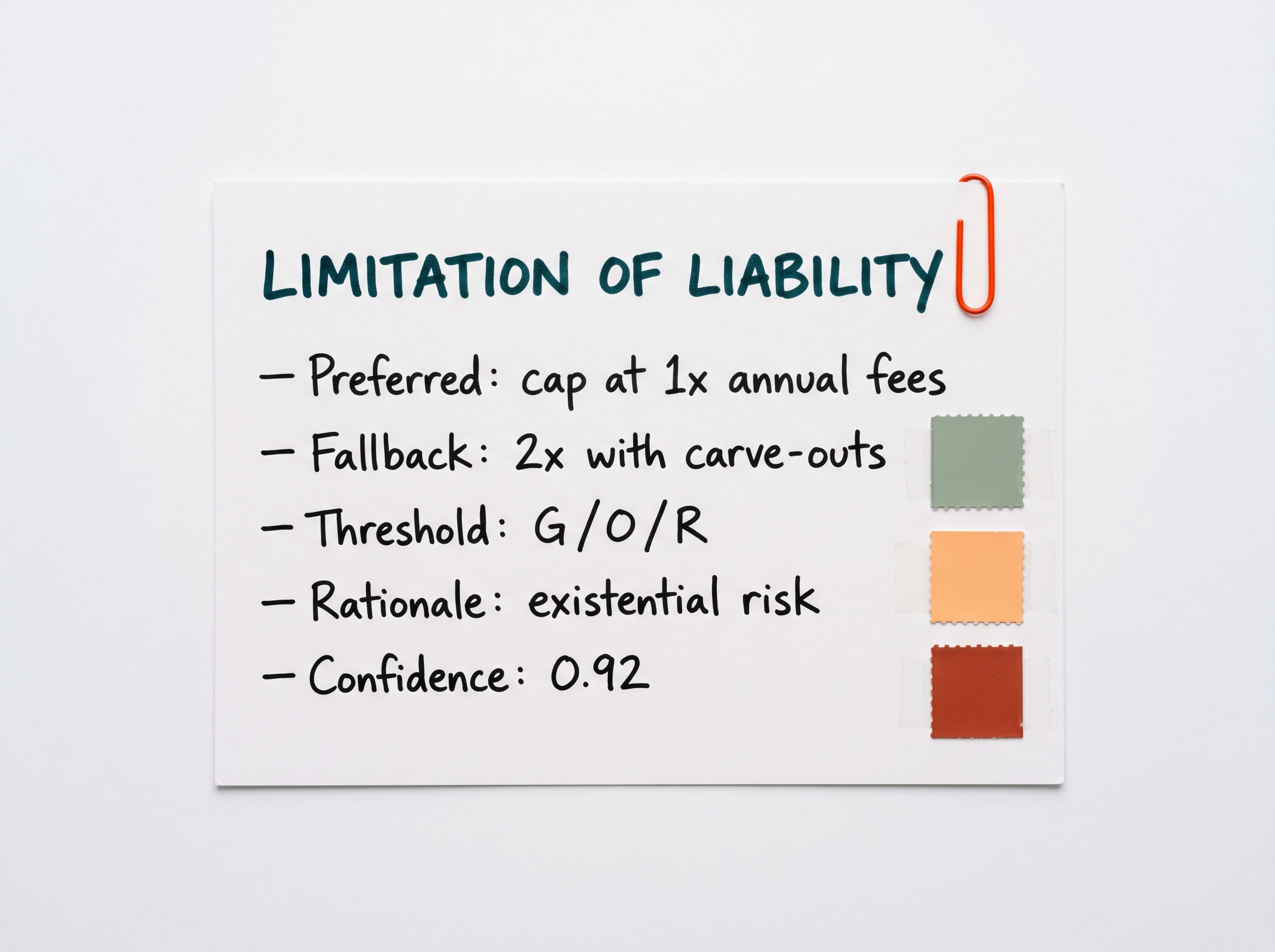
The AI decomposes each term into structured fields: preferred contract language, fallback wording, GREEN/ORANGE/RED risk boundaries, rationale explaining why, and semantic search queries for 1536-dimensional clause matching. Not a prompt — a machine-readable knowledge base.
- Preferred + fallback language stored per term
- GREEN/ORANGE/RED thresholds, individually configurable
- 1,536-dimensional semantic search queries
18+ agents enforce your playbook on every contract.
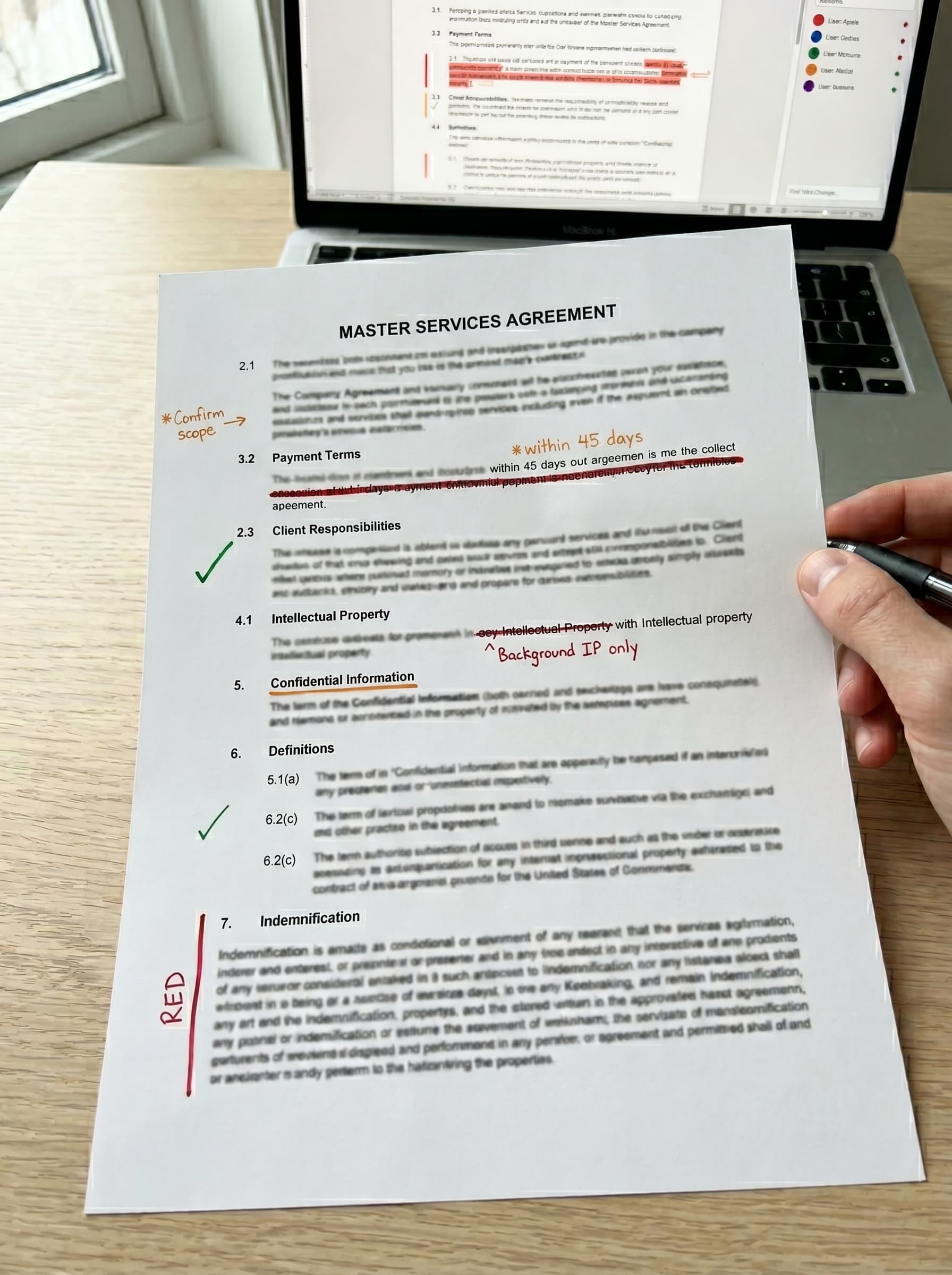
Each legal category maps to a specialist agent. The Warranty agent receives your warranty terms. The IP agent receives your IP terms. All 18+ analyze in parallel — your standards applied identically to every contract, every reviewer, every time.
- One agent per legal category — 18+ total
- Identical enforcement on contract 1 and contract 200
- Approval routing per term and per tier

Sample playbook terms.
Four realistic terms showing the anatomy — preferred position, GREEN/ORANGE/RED thresholds, and rationale.
Limitation of Liability
Preferred: Aggregate liability of either party shall not exceed 1x the total annual contract value. Consequential, incidental, and punitive damages excluded.
Unlimited liability exposes the company to existential financial risk. Industry standard for enterprise contracts is 1x-2x annual fees with mutual consequential damages waiver.
Payment Terms
Preferred: Payment due Net 60 from date of invoice. No advance payment. Late payment interest at 1.5% per month.
Cash flow management requires predictable payment cycles. Terms shorter than Net 30 strain working capital. Advance payments above 25% create counterparty credit risk.
Termination for Convenience
Preferred: Either party may terminate on 90 days written notice. Termination triggers wind-down obligations and payment for work completed.
Adequate notice periods protect against operational disruption. Unilateral short-notice termination can leave deliverables incomplete and resources stranded.
IP Ownership of Deliverables
Preferred: All deliverables created under this agreement shall be work-for-hire and owned exclusively by Client. Supplier retains no rights to deliverables.
Without clear IP ownership, the company risks losing access to deliverables it funded. Revocable or time-limited licenses create long-term dependency on the supplier.
Playbook vs alternatives.
How a structured playbook compares to generic AI prompts and manual review checklists.
| Paralegent AI Playbook | Generic AI Prompts | Manual Checklists | |
|---|---|---|---|
| Term granularity | 80-150 structured terms | Single prompt | 10-30 checklist items |
| Risk classification | GREEN/ORANGE/RED per term | Pass/fail or none | Subjective |
| Preferred positions | Stored per term, auto-suggested | Not supported | Informal |
| Fallback language | Pre-approved per term | Not supported | Ad hoc |
| Approval routing | Configurable per term + tier | Not supported | Email/Slack |
| Semantic matching | 1536-dimensional vectors | Keyword/regex | Manual |
| Consistency | 100% — same standards every time | Prompt-dependent | Reviewer-dependent |
When your standards become enforceable.
Five outcomes when your guidelines stop being narrative and start being machine-readable.
- 80-150 terms, individually configurable. Each term carries its own preferred position, fallback, thresholds, rationale, and approval routing.
- Upload once, enforce forever. Build the playbook during implementation. Every future contract review uses it automatically.
- Zero reviewer variation. Same standards applied on contract 1 and contract 200. New associates review with the same rigor as your GC.
- Evolves with your organization. Edit any field of any term at any time — without re-uploading. The next review uses the updated version.
- Multiple playbooks per org. Separate playbooks for MSAs, NDAs, vendor onboarding, software licenses. Each with its own terms and routing.
Keep reading.


See your playbook enforced on every contract.
Request a demo — we'll extract your contract guidelines into a structured playbook and show you the term anatomy live.
Playbook questions.
Common questions about the playbook system — from term anatomy and extraction to configuration and multi-playbook management.
What exactly is a playbook in Paralegent AI?
A playbook is a structured digital representation of your company's contract review standards. Each playbook contains 80-150 individually configurable terms — each with a preferred position, fallback language, GREEN/ORANGE/RED risk thresholds, rationale, and approval routing. It encodes institutional knowledge that would otherwise live in senior lawyers' heads.
How does the playbook differ from a contract playbook?
Most legal teams use "playbook" to describe narrative guidelines stored in Word or PDF. A Paralegent AI playbook decomposes those guidelines into machine-readable terms with structured fields — preferred position, fallback language, GREEN/ORANGE/RED boundaries, rationale, and semantic search queries. Every field is individually configurable and enforceable by the AI.
What file formats can I upload?
Paralegent AI accepts PDF and DOCX files up to 50MB. Your existing contract review checklist, legal department guidelines, or compliance guide can be uploaded directly — no reformatting required. The extraction engine parses headings, bullet points, tables, and narrative paragraphs to identify individual terms and their associated positions.
What is a "preferred position" in a playbook term?
A preferred position is your company's ideal contract language for a specific term. For example, your preferred liability cap might be 'aggregate liability not to exceed 1x annual contract value.' When the AI finds a clause that deviates from this position, it flags the deviation and suggests your preferred wording as replacement language.
How do GREEN, ORANGE, and RED thresholds work per term?
Each playbook term defines its own risk boundaries independently. A liability cap term might set GREEN at 1x-2x annual fees, ORANGE at 2x-5x, and RED at anything above 5x or unlimited. A termination notice term might set GREEN at 90+ days, ORANGE at 30-89 days, and RED below 30 days. Fully customizable per term.
Can I maintain multiple playbooks?
Yes — Paralegent AI supports unlimited playbooks per organization. A procurement team might maintain separate playbooks for master service agreements, NDAs, vendor onboarding contracts, and software license agreements. Each playbook has its own terms, thresholds, and approval routing. You designate one as the default for quick reviews.
How does approval routing work?
Each term can specify different approvers based on risk tier. An ORANGE liability clause might route to VP Legal, while a RED intellectual property violation escalates directly to General Counsel. Approval routing is configured per term and per risk tier, ensuring the right stakeholder reviews the right risk.
What are confidence thresholds?
Confidence thresholds define the minimum AI confidence score required before a finding is surfaced. If a term's confidence threshold is set to 0.75, the system only flags clauses where the AI is at least 75% certain the clause matches that term. This eliminates false positives and ensures reviewers see only high-confidence findings.
How does semantic search work inside a playbook term?
Each term includes semantic search queries — natural language descriptions of what contract language should match. For example, a "Limitation of Liability" term might include queries like "cap on damages," "maximum aggregate liability," and "exclusion of consequential damages." These enable 1536-dimensional meaning-level clause matching.
Can I edit terms after extraction?
Yes — every field of every term is fully editable after extraction. Adjust thresholds, rewrite fallback language, change approval routing — without re-uploading or re-extracting. The playbook evolves with your organization. 18+ agents use the latest version on every subsequent review automatically.