Paralegent AI

Redlines & Findings

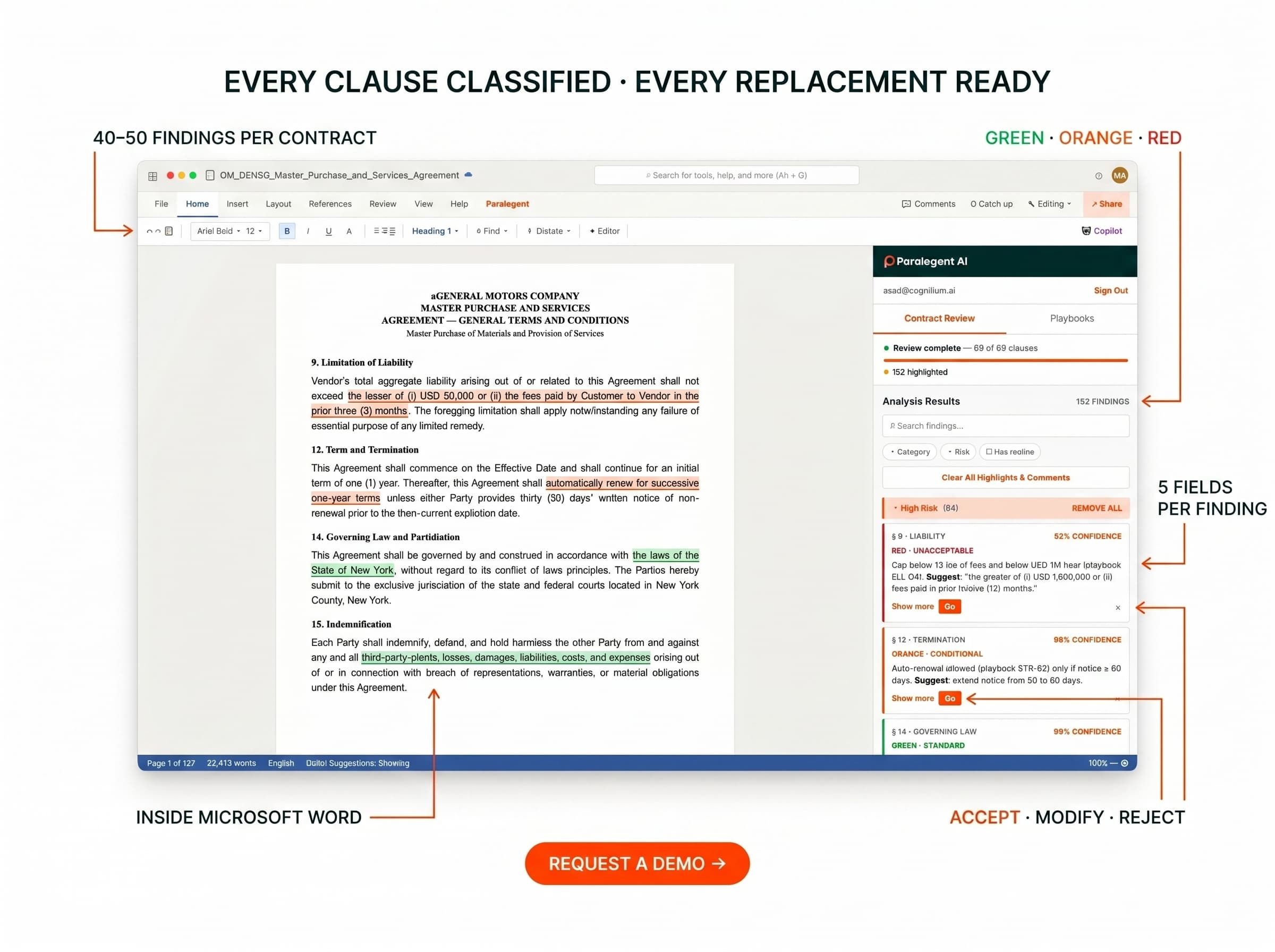
40-50 findings per contract. Every one actionable.

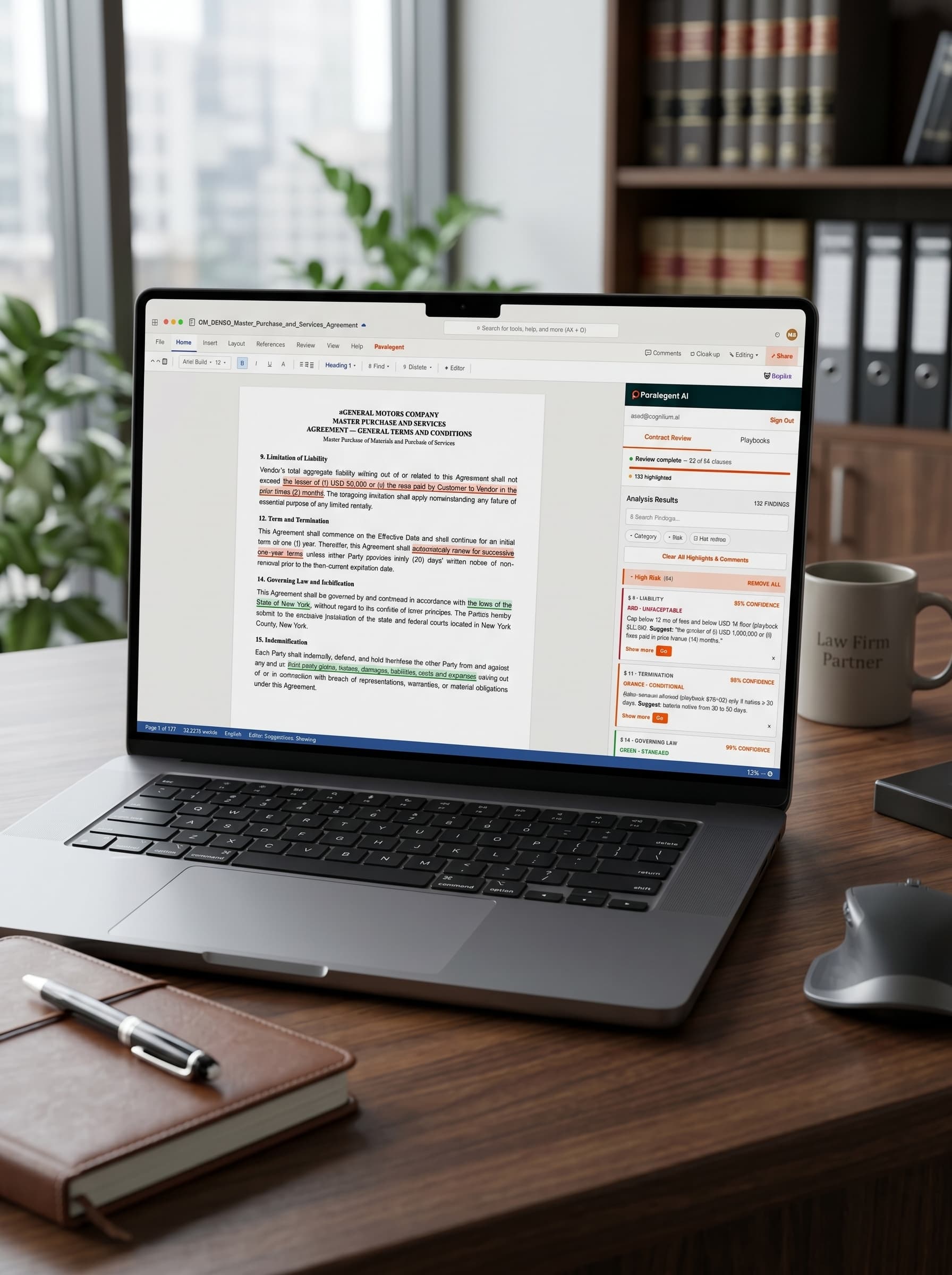
Every clause classified. Every finding explained. Every replacement ready. This is the deliverable your legal team actually uses — inside Microsoft Word, ready for negotiation. GREEN means go. ORANGE means escalate. RED means renegotiate.

Structured output with 5 fields per finding — not vague AI summaries.

40-50 Findings per MSA
3 Risk Tiers
5 Fields per Finding
Full Analysis in 2-8 minutes

How It Works

Every clause classified. Every finding structured.

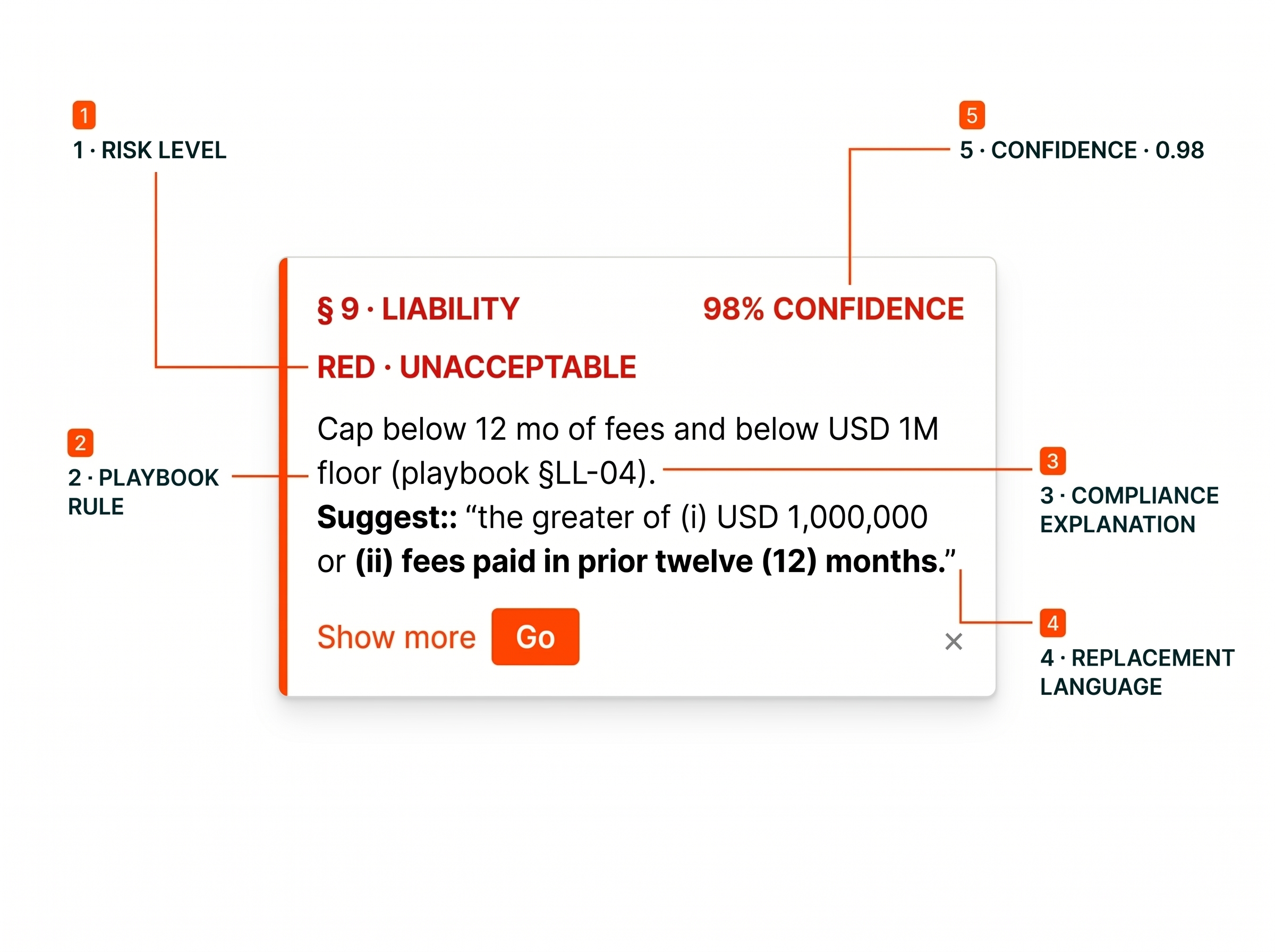
Paralegent AI does not produce vague summaries. Every finding has five structured fields — risk level, rulebook rule, explanation, replacement language, and confidence score.

Classification

Every clause classified GREEN, ORANGE, or RED

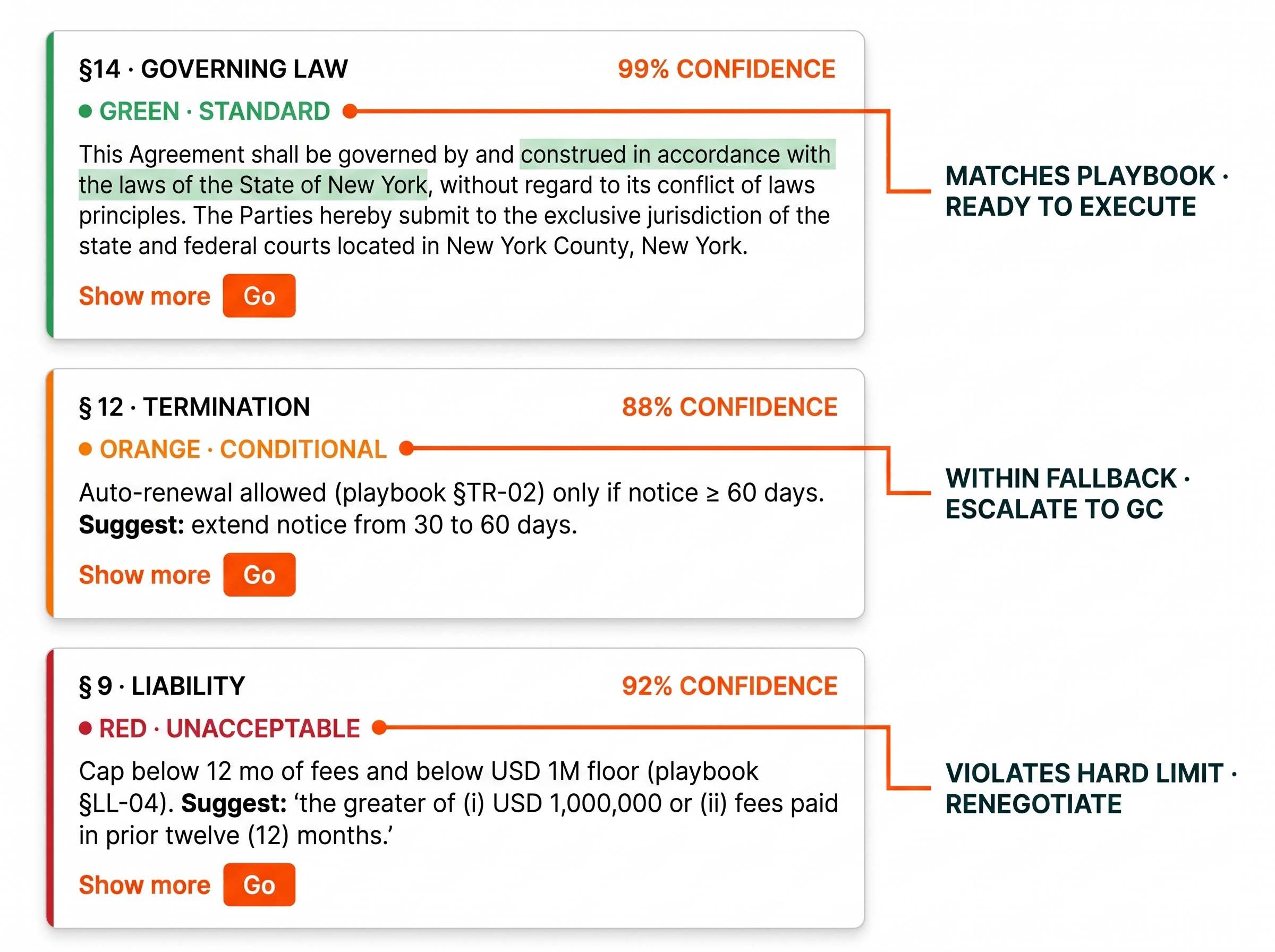
The 3-tier classification system maps directly to action. GREEN means the clause matches your rulebook — no action needed. ORANGE means it deviates from preferred but falls within your fallback threshold — route to senior counsel. RED means it violates hard limits with no fallback — renegotiate immediately. No ambiguity about what to do next.

Paralegent AI GREEN ORANGE RED three-tier contract classification

Structure

5 structured fields per finding

Every finding includes: (1) Risk level — GREEN, ORANGE, or RED. (2) Rulebook rule — the exact term from your 80-150-term rulebook that was violated. (3) Compliance explanation — plain-language reasoning. (4) Replacement language — your approved preferred or fallback wording. (5) Confidence score — 0.0 to 1.0 certainty. Teams use this structure to triage 40-50 findings in under 30 minutes.

Paralegent AI structured finding with five fields per redline

Replacement

Replacement language from your rulebook

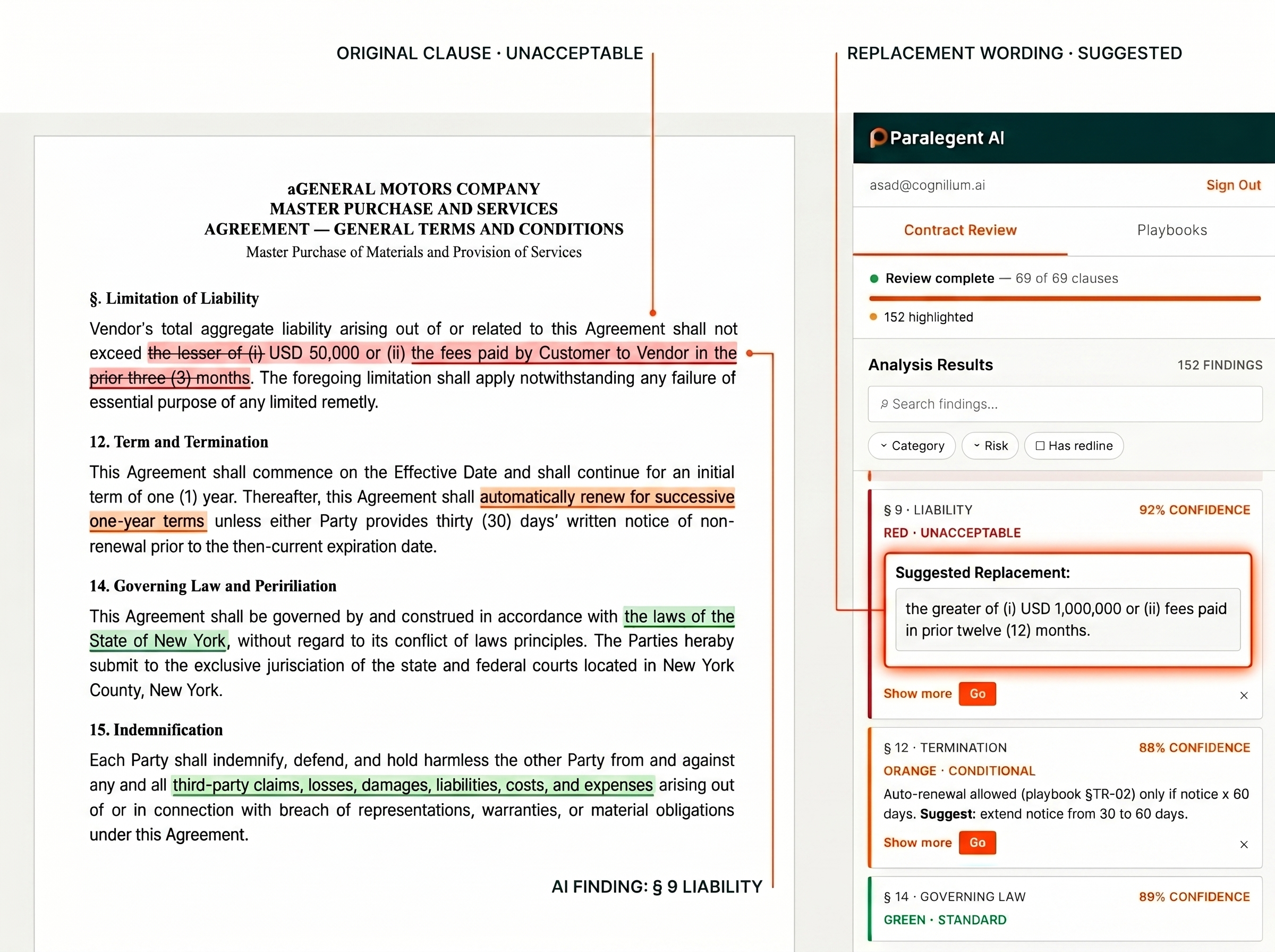
Every replacement suggestion comes from YOUR rulebook — preferred positions for RED findings, fallback positions for ORANGE findings. Not generic AI suggestions from training data. Your approved wording, applied consistently across every contract, every reviewer. Copy-paste ready in the Microsoft Word sidebar with a single click.

Paralegent AI replacement language from custom rulebook in Microsoft Word

The Problem

Generic AI says “potential issue.” Paralegent AI tells you exactly what to do.

Most AI contract tools produce vague warnings with no rulebook traceability, no classification, and no replacement language. Paralegent AI delivers 40-50 findings per MSA — each with the specific rulebook rule violated, a plain-language explanation, and your approved replacement text. The output is the same whether a junior associate or senior partner runs the review.

Classification Examples

See what each risk tier looks like.

Three real-world examples showing the full anatomy of a Paralegent AI finding — GREEN (favorable), ORANGE (conditional), and RED (unacceptable). Each includes the rulebook rule, explanation, replacement language, and confidence score.

GREEN — Favorable

Payment Terms — Net 60 Days

Matches Rulebook Term 2.1: Payment Terms. Net 60 days falls within the preferred range of Net 30-60. No action required — clause is ready for execution. Confidence: 0.97.

Buyer shall pay all undisputed invoices within sixty (60) days of receipt of a valid invoice.

ORANGE — Conditional

Warranty Duration — 3 Years

Exceeds preferred 2-year warranty (Rulebook Term 5.2: Warranty Period) but falls within fallback threshold of 3 years. Conditionally acceptable — requires General Counsel approval for deals above $500K. Confidence: 0.82.

Supplier warrants that the Products shall be free from defects in materials and workmanship for a period of three (3) years from the date of delivery.

RED — Unacceptable

Unlimited Liability — No Cap

Violates Rulebook Term 4.3: Limitation of Liability. Hard limit is 12 months of fees paid — no fallback exists. Must be renegotiated. Replacement: mutual cap at 12 months of aggregate fees with consequential damages excluded. Confidence: 0.98.

Supplier's liability under this Agreement shall be unlimited and shall include all direct, indirect, and consequential damages.

Output Comparison

Paralegent AI redlines vs alternatives.

What you actually receive matters more than how the AI works. Compare the output quality — not just the technology.

Paralegent AI RedlinesGeneric AI OutputManual Attorney Notes
Findings per MSA40-50 precise10-20 vague15-25 (varies by reviewer)
Risk ClassificationGREEN/ORANGE/REDPass/Fail or noneSubjective notes
Rulebook TraceabilityExact rule cited per findingNo rulebookReviewer memory
Compliance ExplanationPlain language per findingGeneric warningsExpert judgment (varies)
Replacement LanguageFrom your rulebook — preferred + fallbackGeneric suggestionsAd hoc drafting
Confidence Score0.0-1.0 per findingNoneNone
Summary ReportRisk distribution + category breakdownBasic listManual compilation
ConsistencyIdentical across all reviewersModel-dependentVaries by attorney
Delivery Time2-8 minutes5-10 min20-30 hours
Approval RoutingAuto-routed by tier + confidenceNoneManual escalation

What Changes

When every finding is structured and traceable.

40-50 findings, each with 5 fieldsRisk level, rulebook rule, compliance explanation, replacement language, and confidence score — sourced from your 80-150-term rulebook.

GREEN/ORANGE/RED tells your team exactly what to doGREEN means approve. ORANGE means escalate to senior counsel. RED means renegotiate with the approved replacement text.

Replacement language from your approved positionsPreferred wording for RED findings, fallback wording for ORANGE. Not generic AI suggestions — your legal department's exact language.

Confidence scoring enables 30-minute triageHigh-confidence RED findings (0.85+) are reviewed first. Then ORANGE sorted by certainty. GREEN confirmed in bulk.

Consistent output regardless of reviewerJunior associates and senior partners get identical findings. The rulebook — not individual expertise — drives every classification.

Paralegent AI delivers 40-50 structured findings per contract — each with GREEN/ORANGE/RED classification, rulebook traceability, and replacement language from your approved positions.

See the Output

See GREEN/ORANGE/RED classification on your contracts.

Request a demo — we review one of your MSAs live and show every finding with classification, replacement language, and confidence score.

40-50 findings per MSA
GREEN/ORANGE/RED classification
Replacement from your rulebook
Full analysis in 2-8 minutes

FAQ

Redlines & findings questions.

Common questions about the classification system, confidence scoring, replacement language, and how to prioritize 40-50 findings efficiently.

How many redline findings does Paralegent AI produce per contract?

Paralegent AI produces 40-50 precise redline findings per 80-page MSA. Each finding includes a 3-tier risk classification (GREEN, ORANGE, or RED), the specific rulebook rule violated, a compliance explanation, AI-generated replacement language, and a confidence score.

What are the five parts of a Paralegent AI redline finding?

Every finding has five components: (1) Risk level — GREEN, ORANGE, or RED classification. (2) Rulebook rule — the specific term from your rulebook that was violated. (3) Compliance explanation — why the clause was flagged, in plain language. (4) Replacement language — alternative wording from your approved positions. (5) Confidence score — how certain the agent is about the classification.

What does a GREEN classification mean?

GREEN means the clause matches your rulebook's preferred or acceptable position. No action is required — the term is favorable and ready for execution. Example: "Payment within Net 60 days" when your rulebook allows Net 30-60 as the preferred range. GREEN findings confirm alignment.

What does an ORANGE classification mean?

ORANGE means the clause is conditionally acceptable — it deviates from your preferred position but falls within your fallback threshold. It typically requires senior counsel or General Counsel approval before execution. Example: a 3-year warranty when your standard is 2 years but your fallback allows up to 3 years.

What does a RED classification mean?

RED means the clause is unacceptable — it violates your rulebook's hard limits with no fallback position. These are deal-breakers that must be renegotiated before signing. Example: unlimited liability when your rulebook caps liability at 12 months of fees. RED findings always include replacement language.

How does the confidence score work?

Each finding includes a confidence score from 0.0 to 1.0 indicating how certain the AI agent is about its classification. High-confidence RED findings (0.85+) should be prioritized for immediate legal review. Borderline ORANGE findings (0.50-0.65) may need human judgment to determine the final classification.

Where does the replacement language come from?

Replacement language is sourced directly from YOUR custom rulebook — not generated from generic AI training data. Each rulebook term includes preferred positions and fallback language. When a clause is flagged, the system suggests your approved alternative wording, ensuring consistency across all contracts.

What does the summary report include?

The summary report shows the overall risk distribution (how many GREEN, ORANGE, and RED findings), a category breakdown across all 18+ legal categories, findings sorted by confidence score, and an approval chain recommendation — which findings need GC approval versus standard review. Full analysis completes in 2-8 minutes.

Can I customize which findings require approval?

Yes — your rulebook defines the thresholds. You control which terms are GREEN (auto-approve), ORANGE (conditional with senior review), and RED (must renegotiate). The confidence threshold for escalation is also configurable per legal category, so your team reviews only what matters.

How do teams prioritize 40-50 findings efficiently?

Teams prioritize by combining risk level and confidence score. High-confidence RED findings (0.85+) are reviewed first — these are clear deal-breakers. Then ORANGE findings sorted by confidence. GREEN findings are confirmed quickly. Most teams complete full review of all 40-50 findings in under 30 minutes.