The legal-AI glossary.
14 plain-English definitions for the terms that matter in production AI contract review — playbooks, multi-agent orchestration, GREEN/ORANGE/RED, due diligence, data sovereignty, and more. Written by the team building 18+ AI specialists deployed in customers’ own cloud.
The vocabulary has been hijacked.
Every SaaS contract-AI vendor uses the same words — playbook, agents, multi-agent, orchestration. The words mean something specific when implemented correctly. This glossary defines each one in the context of actual production contract review — not marketing copy.
Index of 14 terms.
- Contract Redlining. The editing process of marking proposed changes inside a contract document.
- Contract Playbook. A structured ruleset that encodes a legal team's review standards.
- Multi-Agent AI. An orchestration architecture where specialized AI agents each handle one domain.
- GREEN / ORANGE / RED Classification. A 3-tier risk taxonomy applied to every clause in a contract.
- Master Services Agreement (MSA). A top-level contract governing the overall relationship between two parties.
- Contract Due Diligence. The pre-signing risk review of every clause in a contract.
- AI Orchestration. The coordination layer that routes work between AI agents and resolves conflicts.
- Semantic Search (1536-d Vectors). Vector-embedding similarity used to match contract clauses to playbook rules.
- Confidence Score. A numerical certainty value attached to each AI-generated finding.
- Data Sovereignty. The principle that data stays in the customer's own environment.
- Legal AI Accelerator. A production AI system deployed inside the customer's cloud — not SaaS.
- Microsoft Word Add-in. A native Word panel that brings AI contract review into the document.
- LLM-Agnostic. Designed to run with any large language model provider.
- Clause Analysis. Section-level contract review applied to every clause individually.
Contract Redlining
The editing process of marking proposed changes inside a contract document.
Contract redlining is the process of proposing additions, deletions, and edits to a contract — historically with red pen, now with tracked changes inside Microsoft Word. Every redline is a negotiation move: a clause the receiving party wants softened, removed, or rewritten before signing.
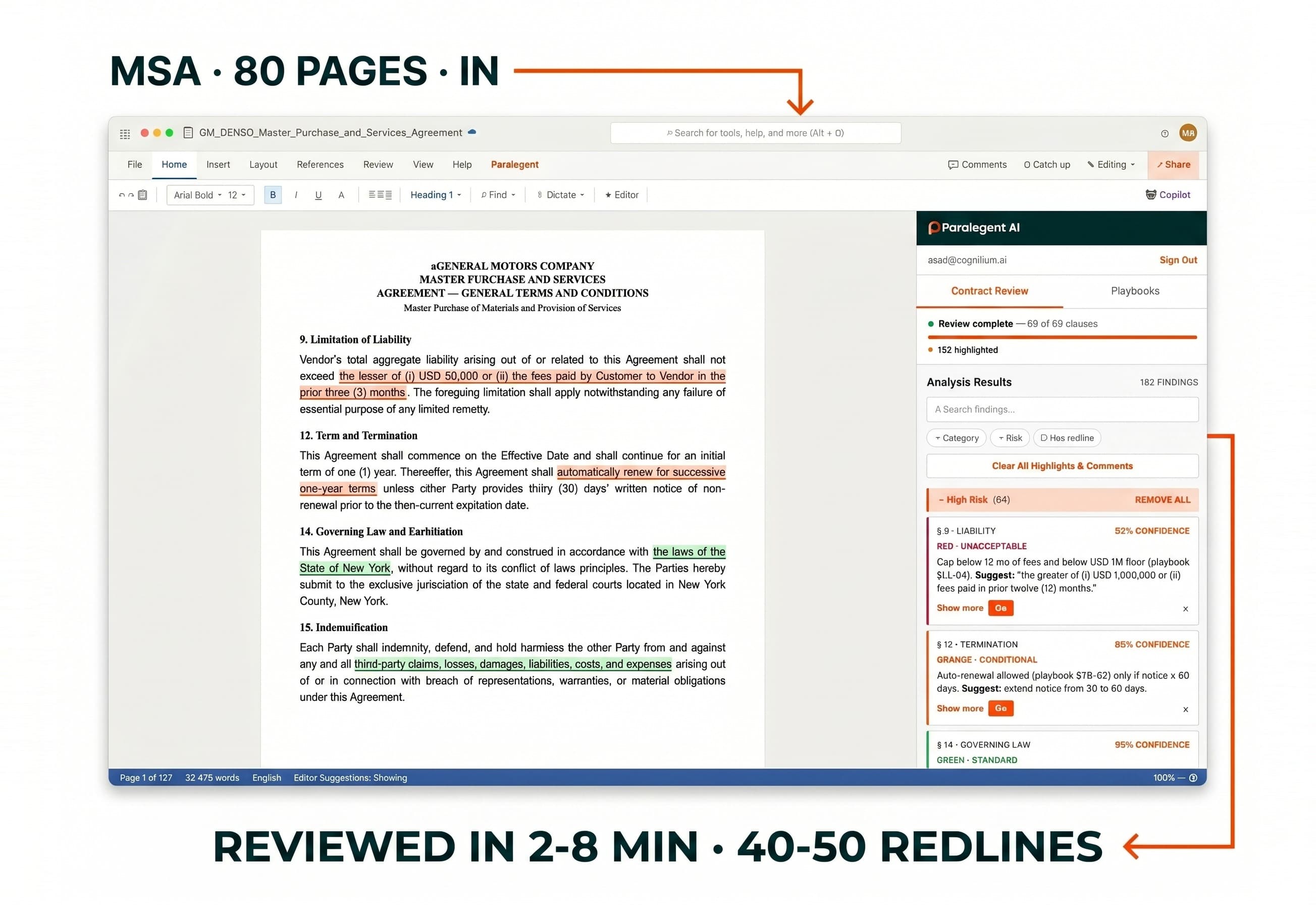
Why it matters: For an 80-page master agreement, manual redlining produces 40-50 changes and consumes 20-30 attorney hours. Paralegent AI generates 40-50 classified redlines in 2-8 minutes — each with the playbook rule that triggered it, plain-language rationale, and your approved replacement language ready to insert.
Contract Playbook
A structured ruleset that encodes a legal team's review standards.
A contract playbook is a deeply structured knowledge base capturing a legal team's preferred positions, fallback language, and risk thresholds for every clause type. Unlike a checklist or template, a playbook is enforceable — each rule has a definition, rationale, examples, and a risk classification.
Why it matters: Paralegent AI converts your playbook PDF or DOCX into 80-150 structured terms across 18+ legal categories. Once encoded, every contract is reviewed against the same standard — no reviewer drift, no missed clauses, no inconsistent positions across the team.
Multi-Agent AI
An orchestration architecture where specialized AI agents each handle one domain.
Multi-agent AI is an architecture pattern where multiple specialized AI agents — each focused on one narrow domain — work in parallel, with an orchestrator agent resolving conflicts between them. Compare to single-model AI (one generic LLM trying to do everything), which produces lower accuracy and longer context windows.
Why it matters: Paralegent AI deploys 18+ specialist agents — ScopeAnalyst, IPRightsAnalyst, TerminationAnalyst, etc. — each analyzing only the clauses in its domain. An orchestrator scores findings by confidence and surfaces only the highest-confidence redlines. Result: 75% fewer LLM API calls than single-model approaches and higher per-clause accuracy.
GREEN / ORANGE / RED Classification
A 3-tier risk taxonomy applied to every clause in a contract.
GREEN/ORANGE/RED is a 3-tier risk classification system applied to each clause in a contract review. GREEN means favorable — aligns with your standard, ready to execute. ORANGE means conditional — acceptable with senior approval or specific safeguards. RED means unacceptable — must be renegotiated before signing.
Why it matters: The taxonomy gives attorneys a triage shortcut: skip the GREEN, review the ORANGE, escalate the RED. It replaces subjective reviewer judgement with consistent classification across every contract, every reviewer, every time. Every classification carries the playbook rule that triggered it plus a confidence score.
Master Services Agreement (MSA)
A top-level contract governing the overall relationship between two parties.
A Master Services Agreement (MSA) is the top-level contract that defines the overall terms — payment, liability, IP, termination, warranty, indemnification — under which two parties do business. Specific projects are then executed through Statements of Work (SOWs) or Purchase Orders that inherit MSA terms.
Why it matters: MSAs are the highest-risk contracts in most enterprise legal portfolios. They're 60-100+ pages, contain hundreds of clauses, and lock in terms for multiple years. A single missed indemnification clause in an MSA can expose a company to unlimited liability across every downstream SOW. This is where AI contract review delivers the largest time savings.
Contract Due Diligence
The pre-signing risk review of every clause in a contract.
Contract due diligence is the systematic pre-signing review of a contract — identifying risky clauses, classifying them by severity, and confirming each one aligns with the reviewing party's standards before execution. It's the legal team's last defense against a bad contract.
Why it matters: Paralegent AI is built specifically as a contract due-diligence accelerator. Industry research shows lawyers spend 40-60% of working hours on document review — most of it due diligence. Cutting that 30 hours → 30 minutes per contract frees your team for negotiation, strategy, and the deals that actually move the business.
AI Orchestration
The coordination layer that routes work between AI agents and resolves conflicts.
AI orchestration is the coordination layer that decides which agent gets which work, in what order, and how to resolve conflicts between agents' outputs. In legal AI it determines clause routing (which specialist analyzes which section), parallel execution timing, and confidence-weighted result merging.
Why it matters: Without orchestration, multi-agent AI is just a parallel collection of independent models — with no way to merge findings or resolve disagreement. Paralegent AI's orchestrator is built on LangGraph and Google ADK, scores every finding by confidence, and surfaces only high-confidence results. It's the difference between 18+ separate analyses and one coherent contract review.
Semantic Search (1536-d Vectors)
Vector-embedding similarity used to match contract clauses to playbook rules.
Semantic search uses high-dimensional vector embeddings (1,536-dimensional in Paralegent AI) to find the playbook rule most similar in meaning to each contract clause — not just keyword matches. Two clauses with no shared words can still be matched if they express the same concept.
Why it matters: Keyword search misses paraphrased clauses. Semantic search catches them. Paralegent AI uses 1,536-dimensional embeddings to map every contract chunk to the matching rule in your 80-150-term playbook — completing the match in 15-20 seconds per contract regardless of length. This is what enables full MSA matching in seconds instead of minutes.
Confidence Score
A numerical certainty value attached to each AI-generated finding.
A confidence score is a numerical value (typically 0-100) attached to each AI-generated finding indicating how certain the model is in its analysis. High confidence (90+) means surface the finding; low confidence (<70) means filter it out or require human review.
Why it matters: Confidence scoring is what makes multi-agent AI usable in a legal context. Paralegent AI's orchestrator scores every finding from every specialist agent, then filters low-confidence outputs before they reach your attorneys. The result: lawyers see only high-signal findings instead of wading through noisy AI suggestions.
Data Sovereignty
The principle that data stays in the customer's own environment.
Data sovereignty in enterprise software means customer data never leaves the customer's controlled environment. For contract review, this means contracts are processed inside the customer's own Azure, AWS, or Google Cloud tenancy — not shipped to a SaaS vendor's servers.
Why it matters: Most contract AI is SaaS — you upload contracts to a vendor and trust their security posture. Paralegent AI inverts this: it deploys as an accelerator inside your cloud, uses your own LLM accounts (Azure OpenAI / AWS Bedrock / Google Vertex AI), and inherits your existing SOC 2, ISO 27001, and FedRAMP posture. Zero data egress. You own the system end-to-end.
Legal AI Accelerator
A production AI system deployed inside the customer's cloud — not SaaS.
A legal AI accelerator is a production-grade AI system delivered as code and infrastructure, not as a subscription service. The customer owns the deployed system, runs it in their own cloud, and pays a one-time license plus engineering implementation — no monthly per-seat fees.
Why it matters: The accelerator model emerged because enterprise legal teams cannot send contracts to vendor servers. By deploying inside the customer's cloud, the accelerator inherits the customer's existing security, compliance, and procurement processes. Paralegent AI ships as an 8-10 week engineering implementation by a 3-4 engineer pod with deep AI experience.
Microsoft Word Add-in
A native Word panel that brings AI contract review into the document.
A Microsoft Word add-in is a native task pane that runs inside Word and integrates with the document open in the editor. Built on Microsoft's Office.js API, it can read the document, insert comments, mark redlines, and call external services. Works in Word Desktop (Windows, Mac) and Word Online.
Why it matters: Attorneys don't want to switch tools — they live in Word. Paralegent AI's Word add-in reads the open contract, sends it for analysis, and writes findings back as native Word comments anchored to the exact clauses. GREEN/ORANGE/RED classifications appear inline; 40-50 redlines per MSA show up in 2-8 minutes. No context switching.
LLM-Agnostic
Designed to run with any large language model provider.
An LLM-agnostic system is architected so the underlying language model is a swappable component — the customer can use Azure OpenAI, AWS Bedrock, Google Vertex AI, or any other provider without re-implementing the system. The orchestration, playbook engine, and add-in layer remain unchanged.
Why it matters: LLM lock-in is a real risk in enterprise AI deployments. Pricing changes, model deprecations, and shifting compliance requirements can all force a provider switch. Paralegent AI is LLM-agnostic by design — built on LangGraph and Google ADK, it runs on Azure OpenAI, AWS Bedrock, or Google Vertex AI using the customer's own accounts.
Clause Analysis
Section-level contract review applied to every clause individually.
Clause analysis is the practice of reviewing a contract one clause at a time — applying domain expertise (warranty, IP, termination, etc.) to each section and producing a structured finding. Compare to paragraph-summary AI that gives an overall risk assessment without flagging specific clauses.
Why it matters: Paragraph-level AI summaries miss the precise change requests attorneys need. Paralegent AI does true clause analysis — every flagged clause produces a redline with the exact location, the playbook rule violated, a compliance explanation, and replacement language. The output is actionable, not advisory: 40-50 ready-to-insert redlines per MSA.
Five reasons vocabulary precision matters.
A shared, precise vocabulary is the foundation for evaluating any legal AI investment.
- The vocabulary has been hijacked. SaaS vendors use "playbook," "agents," "multi-agent" loosely — often describing single-model AI with checklists. The terms have specific operational meaning when implemented correctly.
- GC and Legal Ops need to evaluate vendors precisely. When a vendor says "our AI uses agents," you need to know: how many? specialized how? orchestrated how? This glossary gives you the diagnostic questions to ask.
- Procurement needs accurate RFP language. RFP requirements like "multi-agent contract review with confidence scoring" only work if everyone agrees what the terms mean. This glossary is the shared reference.
- Internal stakeholders need a common vocabulary. When General Counsel briefs the CFO on a legal AI investment, "playbook" and "data sovereignty" need precise definitions — not buzzwords.
- The terms map directly to product decisions. Every term in this glossary corresponds to a specific architectural decision in production legal AI. Understand the term, understand the trade-off.
Same word, different meaning.
How SaaS contract-AI vendors use these terms versus how production accelerators implement them.
| Term | SaaS Vendor Usage | Paralegent AI Usage |
|---|---|---|
| Playbook | Generic checklist or prompt template | 80-150 structured rules with rationale + classification |
| Agents | Marketing term for one LLM with prompts | 18+ domain-specialized agents + orchestrator |
| Deployment | Multi-tenant SaaS — your data on vendor servers | Your cloud — Azure, AWS, or Google Cloud you own |
| Pricing | Per-user monthly subscription, often $99-$200/user | One-time license + engineering implementation |
| Classification | Paragraph-level "risk summary" | Clause-level GREEN/ORANGE/RED with confidence score |
| Redlines | Suggested text edits to copy/paste | Native Word comments with playbook rule + replacement language |
| LLM Provider | Locked to vendor's chosen model | LLM-agnostic — Azure OpenAI / Bedrock / Vertex AI |
| Output Format | Chat transcript or PDF report | Microsoft Word with native tracked changes |
Frequently asked questions.
What is contract redlining?
What is a contract playbook?
What is multi-agent AI?
What does GREEN / ORANGE / RED classification mean?
What is a Master Services Agreement (MSA)?
What is contract due diligence?
What is AI orchestration?
What is semantic search in contract review?
What is a confidence score?
What is data sovereignty in contract AI?
What is a legal AI accelerator?
How is Paralegent AI's glossary different from generic legal-AI glossaries?
See the vocabulary in action.
Request a demo and we'll walk through how each term in this glossary maps to a specific decision in our accelerator — using one of your contracts as the example.