
AI contract review in 2026: the complete guide

Ali Ahmed
AI Business Analyst & Product Owner, Cognilium AI

Key Takeaway
Can your legal team trust AI contract review, and which architecture earns it? 18+ specialist agents, playbook-driven redlining, 2-8 minute analysis. Real thresholds, real numbers, and what to demand from vendors.
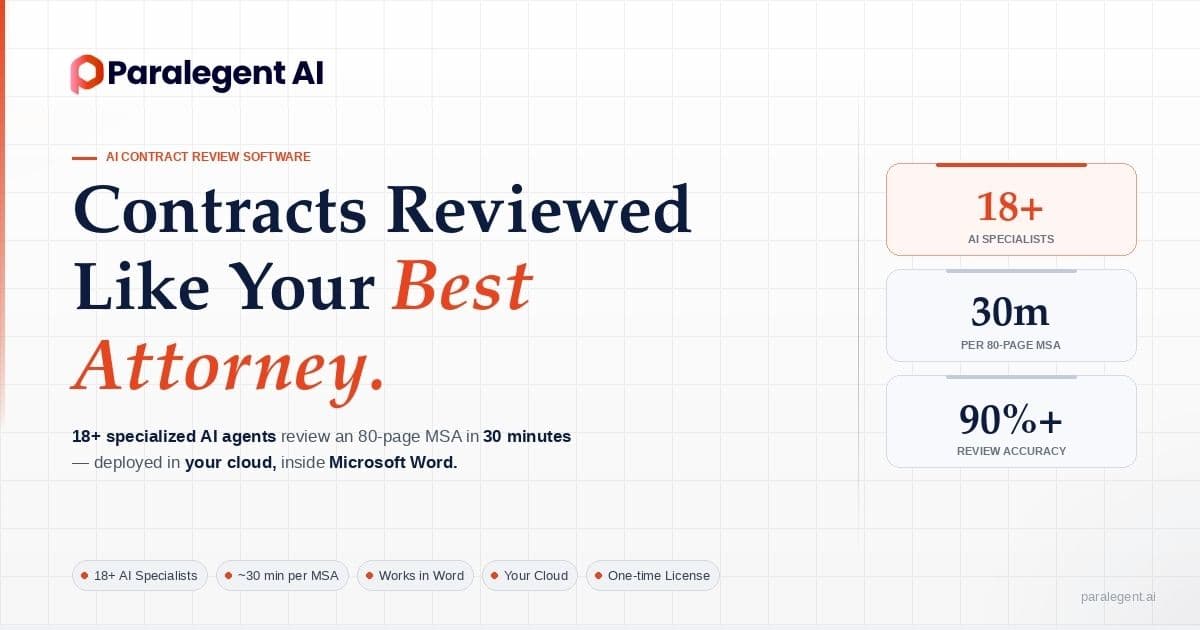
Manual review of an 80-page MSA takes 20-30 hours. Multi-agent AI does it in 2-8 minutes, but only if the architecture is right. The wall most teams hit isn't accuracy; it's trust, and trust is an architecture decision.
60% of legal teams don't trust AI output. They're right to be skeptical.
AI contract review is the use of artificial intelligence to analyze legal contracts, identify risks, and suggest modifications, replacing what traditionally took attorneys 30+ hours per agreement with automated analysis in minutes. In 2026 the technology has moved from keyword matching to multi-agent orchestration: specialized AI for each legal domain, scored against your own playbook.
The manual ceiling: what it looks like
Manual contract review behaves predictably until volume arrives. Lawyers spend 40-60% of their time on repetitive document review. An 80-page Master Sales Agreement routinely takes 20-30 hours. At $150-$750 per hour, that's expensive, and different reviewers produce inconsistent outcomes on the exact same clause. In-house counsel report 89% dissatisfaction with the status quo.
Three signals your review process has hit the ceiling
- The legal team is the SLA. Contracts wait 10-15 days for attorney review while deals idle. Sales escalates; legal triages; nobody wins. When the review queue sets the revenue calendar, the process has outgrown the team.
- Inconsistency shows up in audits. Two attorneys, same clause, different calls. Without a single source of truth for positions and fallbacks, every review is an opinion, and opinions drift.
- Review cost scales linearly with volume. 4-5 attorneys on document review runs $100,000+ per month. Headcount is the only lever manual review has, and it's the most expensive one.
These signals don't arrive as a step function. They compound quarter over quarter. The teams that catch them early are the ones measuring review-cycle time, not the ones waiting for the GC to escalate.
Why single-LLM tools break on contracts
Early AI tools threw one large language model at the entire contract and hoped. That fails for three reasons:
- It applies one-size-fits-all rules instead of your company's negotiated positions.
- It produces unstructured text with no audit trail or confidence scoring.
- Hallucinations and noise overwhelm busy lawyers.
2026's answer is multi-agent orchestration. Instead of one generalist AI trying to be expert in warranties, IP, termination, insurance, and a dozen other categories at once, the system deploys 18+ domain-specific specialist agents plus scoring agents and an orchestrator.
Each specialist lives and breathes one legal category. They work in parallel. The orchestrator compares confidence levels, resolves conflicts, and surfaces only high-confidence findings. Every flag arrives with:
- Exact playbook match
- Business rationale (the “WHY”)
- Real-world examples
- Confidence percentage
What playbook-driven review actually changes
The playbook is the core IP, not a checklist. Each of the 80-150 terms per contract type carries precise GREEN / ORANGE / RED definitions, business rationale, real contract examples, and confidence thresholds. Upload it once; every future contract is judged against it.
How a review runs
- Open the contract in Microsoft Word and click “Review Contract”, no portal, no copy-paste.
- Semantic matching runs against your playbook in 15-20 seconds (1,536-dimensional embeddings).
- 18+ specialist agents analyze every clause in parallel; the orchestrator ranks findings by confidence.
- Results land as color-coded redlines: GREEN (favorable), ORANGE (conditional), RED (unacceptable), each with analysis, suggested revision in your preferred language, and a confidence score.
Lawyers review, accept, reject, or tweak, exactly as they always have, only 10x faster. End-to-end analysis takes 2-8 minutes for even the longest master agreements.
Instant contract matching against your playbook in 15-20 seconds.
SaaS, customer-cloud, generic AI: picking the right shape
SaaS platforms vs customer-cloud deployment
SaaS tools require uploading sensitive contracts to third-party servers, and 62% of legal-tech pilots stall on exactly that data-security wall. Customer-cloud deployment eliminates the risk class: your contracts, your playbook, your LLM keys, everything inside your environment.
Generic AI vs purpose-built legal AI
ChatGPT is impressive for brainstorming and disastrous for contracts. No memory of your negotiated positions, no structured risk tiers, no audit trail, no hallucination guardrails. Purpose-built legal AI is trained on your playbook, speaks only in GREEN/ORANGE/RED, and works inside the document your lawyers already use.
The market in 2026: in real numbers
The playbook is where most of the engineering value lives, and it is the part demos skip. Each contract type, MSA, MPA, master services, carries 80-150 terms, and each term is a structured object, not a sentence:
- The position. What your company accepts, what it accepts conditionally, and what it never accepts, the GREEN / ORANGE / RED boundary for that term.
- The rationale. Why the position exists, the business logic an attorney would explain to a new hire. This is what lets the AI explain its flags instead of just asserting them.
- Real examples. Actual clause language from your negotiated history, favorable and unfavorable, the ground truth the matching runs against.
- When to adopt, and when not to Your preferred replacement wording, so suggested redlines arrive in your voice, not a model's paraphrase.
- Confidence thresholds. How certain the system must be before surfacing a finding for this term, tuned tighter for high-stakes categories like indemnification and IP.
Processing this structure happens once, in 4-8 hours, when the playbook is ingested. From then on every contract is judged against it, consistently, including at 2 a.m. before a quarter-end close, when human consistency is at its weakest.
What the orchestrator actually does
The specialist agents create a new problem while solving the old one: 18+ opinions about one contract. A 40-page MSA produces hundreds of candidate findings, overlapping, sometimes conflicting, varying in confidence. Dumping all of them on an attorney would recreate the noise problem that made single-LLM tools untrustworthy.
The orchestrator is the discipline layer. It deduplicates findings that several specialists raised on the same clause, resolves conflicts by comparing confidence scores against per-term thresholds, ranks what survives, and suppresses everything below the bar. The result is 40-50 findings per master agreement, each one carrying its specialist's rationale, the playbook term it matched, and a confidence score an attorney can sanity-check in seconds.
This is the difference between an AI that generates output and one that exercises judgment about its own output. The second kind is the one legal teams keep using after week three.
The 8-10 week implementation, what actually happens
Production deployment is a project, not an install. A dedicated pod of 3-4 engineers runs it:
| Phase | Weeks | What happens |
|---|---|---|
| Cloud foundation | 1-2 | Deploy into your Azure / AWS / GCP account: functions, queues, storage, database, IAM |
| Playbook ingestion | 2-4 | Your playbook converted to the structured taxonomy; positions and thresholds reviewed with your attorneys |
| Integration | 4-6 | Word add-in rollout, CLM connection (Agiloft, DocuSign, Icertis, Ironclad), SSO |
| Validation | 6-8 | Side-by-side runs on real historical contracts; thresholds tuned against your attorneys' calls |
| Handover | 8-10 | Your team takes operations; access controls locked; engineers exit |
The validation phase is the one to scrutinize in any vendor's plan. If a vendor cannot describe how their output gets benchmarked against your attorneys' historical decisions on your contracts, the accuracy conversation is marketing.
The market in 2026, in real numbers
The AI contract review market sits between $1.75-3.1 billion, growing at 25-30% CAGR. 52% of corporate legal departments now use GenAI; 91% of large law firms use AI for research. Yet 80% still cite accuracy concerns, 62% remain blocked by data-security fears, and 95% of pilots fail at integration or adoption. Meanwhile top-firm billable rates have crossed $1,000/hour. The pressure to automate, safely, has never been higher.
How to evaluate AI contract review tools
Use this checklist before any demo:
| Dimension | What to Demand |
|---|---|
| Deployment model | Data stays in YOUR cloud (Azure / AWS / GCP) |
| AI architecture | 18+ specialized agents with an orchestrator, not a single LLM |
| Playbook depth | Rationale, examples, and confidence scoring, not a checklist |
| Word integration | Native add-in, not a separate portal |
| LLM flexibility | Your own model accounts (Azure OpenAI / Bedrock / Vertex AI) |
| Data handling | True sovereignty, zero vendor servers in the chain |
| Pricing model | One-time license, not a recurring SaaS tax |
| Implementation timeline | Weeks (8-10 with a dedicated pod), not months |
When to adopt, and when not to
Multi-agent, customer-cloud contract review is production infrastructure, not a browser plugin. Implementation runs 8-10 weeks with a dedicated pod of 3-4 engineers. It earns that investment when at least one of three thresholds is true:
- Your volume is past 50 master agreements a year and the review queue sets deal velocity.
- You run 4+ in-house attorneys whose hours are dominated by repetitive review instead of judgment calls.
- Data governance, privilege, GDPR, sector regulation, rules out third-party processing.
Below these thresholds, better templates, a tighter playbook document, or a lightweight SaaS reviewer is usually the honest answer. The result when the thresholds are met: review time drops from 30 hrs → 30 min per MSA, and the attorney SLA from 15 days → 2 days.
How the three modules fit together
Under the hood, playbook-driven review runs as three modules, and understanding the split is the fastest way to tell a real tool from a wrapper around a single prompt. Module 1, playbook processing, runs once: your playbook (PDF or DOCX) is converted into a structured taxonomy of 80 to 150 terms per contract type, each carrying a preferred position, fallback language, and risk definition. Module 2, contract matching, chunks an incoming contract and runs a 1536-dimensional semantic search to map every clause to the right playbook term in 15 to 20 seconds. Module 3, multi-agent analysis, is where the 18+ AI Specialists score each clause and the orchestrator assembles the result, in 2 to 8 minutes for a full master agreement. Keyword tools collapse all three into one lookup, which is exactly why they miss anything written in unfamiliar language.
Anatomy of a result
A finding is only useful if a lawyer can act on it in seconds, so every flag carries four things, not just a color. First, the classification: GREEN (favorable), ORANGE (conditional), or RED (unacceptable), applied at the clause level. Second, the rationale, the reason this clause earned that tier, written against your own playbook rather than a generic standard. Third, a suggested revision in your preferred language, the same fallback wording your team already approved, dropped in as a tracked change. Fourth, a confidence score, so reviewers know which findings to trust on sight and which to inspect. A typical 80-page master agreement comes back with 40 to 50 precise redlines, each located exactly in the document, all inside Microsoft Word through the native add-in.
Master agreements and the contracts beneath them
Most enterprise risk does not live in a single document. A master agreement sets the terms, dozens of sub-contracts inherit them, and that is where manual review quietly breaks. The system handles both tiers. Tier 1 covers the master agreements themselves, MSAs, MPAs, and master service agreements of 40 to 100+ pages, scored in full against your playbook. Tier 2 covers the sub-contracts that hang off them, sales contracts, purchase orders, and statements of work, which are cross-validated against both the governing master agreement and the playbook. That cross-check catches the conflict a human reviewer misses at 6pm on the fortieth purchase order: a payment term in a sub-contract that silently contradicts the master it sits under.
Where a human still decides
Honest vendors draw a line, so here is ours. AI contract review removes the repetitive 90% of the work, the clause-by-clause matching, classification, and first-draft redlining. It does not replace judgment. A genuinely novel clause with no playbook precedent, a business decision to accept a known risk for a strategic account, or a relationship call about how hard to push a counterparty all stay with the attorney, and the system is built to surface those cases rather than bury them. That is the purpose of the ORANGE tier and the confidence score: they route the ambiguous calls to a human instead of guessing. A tool that claims to remove the lawyer is selling the one thing enterprise legal will never buy.
Build, buy, or deploy in your own cloud
Teams usually frame this as build versus buy, but there is a third option that fits enterprise legal better. Building in-house means owning prompt engineering, evaluation, and maintenance forever, a recurring cost most legal teams underestimate. Buying SaaS means renting a workflow that lives on a vendor's servers, with your contracts and your hardest-won playbook locked inside it. Deploying an accelerator in your own cloud is the middle path: production software, implemented by a dedicated pod over 8 to 10 weeks, running on your infrastructure and your choice of LLM, with no per-seat fee and nothing leaving your environment. For a team told to do more with less, the third option is usually the only one that survives both the security review and the budget conversation. For a closer look at how this compares to a general chatbot, see Paralegent versus ChatGPT.
What to read next
If architecture is your open question, Data sovereignty in legal AI covers why deployment model decides enterprise deals. If you're comparing approaches, vs Manual Review and vs ChatGPT show the trade-offs side by side. If you're ready to see it on a real contract, request a demo, 30 minutes, zero technical setup.
Share this article
Ali Ahmed
AI Business Analyst & Product Owner, Cognilium AI
Product manager and AI business analyst at Cognilium AI, specializing in generative AI solutions and automation. Product owner on Paralegent AI, playbook-driven contract review deployed in the customer's own cloud.
AI Business Analyst & Product Owner at Cognilium AI (2024–present)
Next in this series
Frequently asked questions.
Can AI accurately review legal contracts?
Yes, when it is purpose-built with 18+ domain-specific specialist agents, a structured playbook that teaches the AI not just what is risky but why, real examples, and an orchestrator that only surfaces high-confidence findings. Every output includes rationale and confidence score so attorneys can verify quickly instead of starting from scratch. The human remains firmly in the loop; the AI simply eliminates the repetitive 90% of the work.
How long does AI contract review take compared to manual?
Manual review of an 80-page Master Sales Agreement typically takes 20-30 hours. With multi-agent orchestration and Word-native workflow, the same contract is fully analyzed and redlined in 2-8 minutes. SLA drops from 15 days to 2 days.
Is AI contract review safe for confidential documents?
When deployed in your own cloud (Azure, AWS, or GCP) using your own LLM accounts, your contracts and playbook never leave your environment. True data sovereignty, the #1 requirement for enterprise legal teams.
What is multi-agent AI contract review?
Instead of one generic model, the system deploys 18+ specialist agents (one per legal category), scoring agents that pre-filter relevance, and an orchestrator agent that resolves conflicts and ranks by confidence. Parallel processing + domain expertise + intelligent aggregation = dramatically higher accuracy and trust.
Can AI contract review work inside Microsoft Word?
Yes. The Paralegent AI Microsoft Word add-in is native. Open the contract, click one button, and results appear as color-coded highlights and comments directly in the document you already use every day.
What do we need to provide to get started?
Three things: your playbook document (PDF or DOCX, most teams have one as a negotiation guide already), access to a cloud account where the system will deploy, and a set of historical contracts for validation. The playbook is processed once, in 4-8 hours.
Which LLMs does the system use?
Your choice of Azure OpenAI, AWS Bedrock, or Google Vertex AI, under your own service account. The system is LLM-agnostic by design, so you control model selection, costs, and the data-processing terms with the model provider.
How is accuracy validated before go-live?
During weeks 6-8 of implementation, the system runs side-by-side against your attorneys' historical decisions on your own contracts. Confidence thresholds are tuned until the surfaced findings match your team's judgment, accuracy is demonstrated on your documents, not claimed from a benchmark.
What contract types does it handle?
Tier 1: master agreements, MSAs, MPAs, master service agreements of 40-100+ pages. Tier 2: sub-contracts such as sales contracts, purchase orders, and SOWs, which are cross-validated against both the governing master agreement and the playbook.
What changes for attorneys day to day?
They open contracts in Microsoft Word as they always have. The difference is the starting point: instead of a blank read, every clause arrives pre-classified GREEN / ORANGE / RED with rationale and suggested language. Attorneys spend their time on the ORANGE and RED judgment calls, the work that actually requires a lawyer.
Ready to transform your contract review?
See how Paralegent AI analyzes contracts against your playbook with multi-agent orchestration, all inside your own cloud.